Plotter-Cut Film: Efficient, Consistent, and Built on XPEL’s Strength
Plotter-cut, or pre-cut, PPF starts with a digital template. Software stores a pattern for your specific make, model, and year, and a cutting plotter slices each panel’s shape from the roll before anyone touches the car. The installer then lays that shape onto the panel and squeegees it down.
Put plainly: XPEL began as a software and pattern company before it became a film company, and its Design Access Program pattern library is the most refined in the industry. Thousands of vehicles, every panel mapped, every cut tested. A plotter-cut install from that library is repeatable, clean, and keeps a blade entirely away from your paint. It is also efficient, which translates directly into a lower invoice and a shorter time without your car. For the owner who wants real protection from rock chips and road debris, wants it done right, and wants it done at a sensible price, this is the correct choice, not a compromise.
What a pattern cannot do is wrap. A template is designed to fit thousands of cars safely, so it ends a few millimeters short of each panel edge. That leaves a fine line where the film stops, and the paint continues. On a black car or a heavy metallic like Midnight Purple or Nero Daytona, that line all but disappears. On a white, silver, or pale pastel car, you will see it in direct sunlight if you know where to look. For many owners, that is a perfectly acceptable trade for the savings. For some, it is not, and that is where the second method comes in.

Bulk-Cut Film: For the Owner Who Measures in Years, Not Hours
Bulk installation means laying an oversized sheet of film onto the panel and trimming it by hand to fit. Wherever possible, the film wraps around the panel’s edge and tucks behind it, so there is no visible boundary on the painted surface. On a hood, that means the film wraps under the leading edge. On a fender, it tucks into the door gap. On a bumper, it follows every curve and wraps into the wheel well and the grille openings.
The result is coverage with no visible edge, no dirt-collecting lip, and no exposed strip of paint at the panel boundary. The panel stays protected all the way to the edge, where chips and scratches tend to land first.
The trade-off is time and cost. Bulk work needs an installer who can trim film on the car precisely, understands how the material stretches and relaxes around compound curves, and wraps an edge cleanly without over-stretching the film so it wants to pull back. It takes longer per panel, sometimes much longer, and the price reflects those hours. This is the method for the hyper-detailed, long-term owner: the person who plans to keep the car for a decade, who notices things nobody else notices, and for whom fit and finish outrank both the calendar and the budget. Neither owner is wrong. They simply want different things from the same roll of film.

How We Do It
At Bulletproof Auto Spa, we follow the car and the owner, not a fixed rule. As an XPEL-certified installer, we have full access to XPEL’s pattern library, and we use it constantly. On the Midnight Purple Nissan GT-R T-Spec we wrapped in full-vehicle XPEL Ultimate Plus, precision plotter patterns gave us clean, repeatable edges around the R35’s aggressive body lines, and we applied the film wet so we could reposition it across the sculpted front fascia and wide rear quarters before it set. On a dark tri-coat with that much surface geometry, the pattern was the right tool.
On the Nero Daytona Ferrari 296 GTB that came back to us for a full satin transformation, the owner’s brief was different. We applied full-vehicle XPEL Stealth as custom-cut bulk coverage across every painted panel because any satin film with a visible edge on the 296’s buttresses and side intakes would have undercut the entire point of the build. We gave every panel the invisible-edge treatment, and we brought the previously protected front end in line with the rest of the body so the finish reads as one continuous surface from nose to tail.
Most builds land somewhere between the two, and we decide panel by panel. When a pattern gives us a clean, safe cut on a complex piece like a headlight, mirror cap, or sensor cutout, we use it. If the owner wants wrapped edges on a hood, fender, or bumper, we bulk the panel and wrap it. Either way, the standard is the same: the film should end exactly where the owner expects it to, and nowhere else.
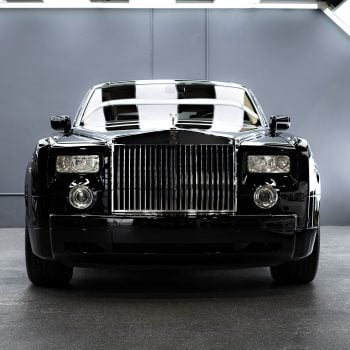
Before we apply any film, we fully decontaminate the paint and, where needed, correct it. PPF is optically clear, so it shows everything underneath. A swirl mark or embedded contamination does not disappear under the film; it gets sealed in for the next ten years. The Black Diamond Rolls-Royce Phantom and the Black Sapphire BMW M2 that came through for multi-stage paint correction received the same standard we apply before film, not a separate service we skip when the car is getting wrapped.
Once the film is down, we inspect every panel under high-intensity lighting before we sign off. No tunneling, no lifting edges, no trapped contamination. On most full builds, we then apply a ceramic coating directly over the film, or a matte-specific coating over Stealth, so the protection is two layers deep: urethane absorbing the impacts, ceramic handling the UV, chemicals, and wash marring on top.

The Cars That Prove It
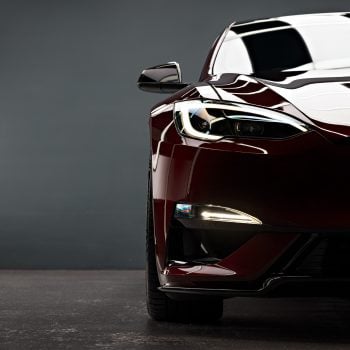
The clearest endorsement is the Tesla Model S Plaid Signature Series #001, the first of Tesla’s 250 numbered send-off cars, which belongs to Tesla Chief Designer Franz von Holzhausen. When the person who drew the car chooses where to protect his own VIN #001, it says something about the standard he expects. That car received full-vehicle XPEL Ultimate Plus, XPEL Prime XR Plus nano-ceramic tint, and a professional-grade ceramic coating over the film, on a Garnet Red paint that Tesla will never mix again.
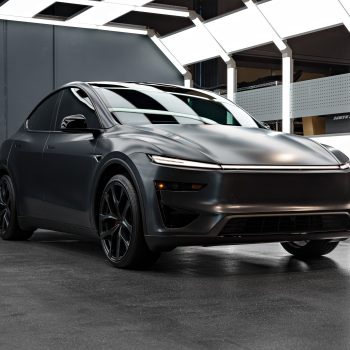
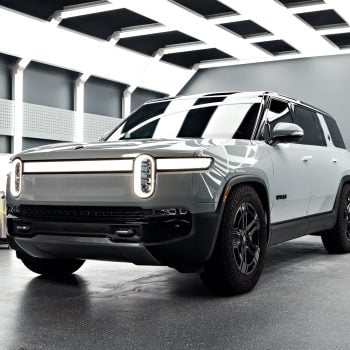
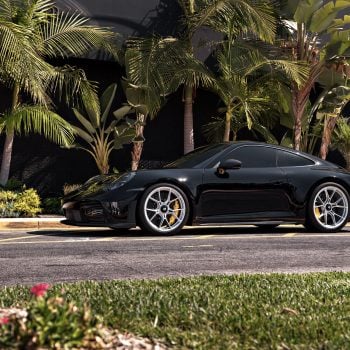
The rest of the recent build list reads the same way. A Porsche 718 Cayman GT4 RS Weissach in Ultimate Plus with windshield protection film. A 2006 Ford GT Heritage Edition, one of the most collectible American cars of the last twenty years. An Ice Silver McLaren GT, a Ferrari 458 Speciale, a Storm Blue Rivian R1T Quad Motor in full paint protection, a Quantum Gray Lucid Gravity in full front-end film, a Toronto Red BMW G83 M4 Competition, an Aqua Blue Metallic Porsche 911 Carrera S, and multiple Model S Plaids and Model Y Performances in XPEL Stealth. These cars have compound curves, tight panel gaps, carbon fiber aero, and paint that requires a full-panel respray to repair. Their owners arrive with very specific expectations, and they keep coming back because we meet them.
They also show the film’s range. XPEL Ultimate Plus is the clear, gloss, 8-mil self-healing film with a 10-year manufacturer warranty, and it is our default for a factory finish you want to keep looking factory. XPEL Stealth is the satin version of the same protection, and it is how the Ferrari 296 GTB and the satin black Model S Plaid got their finish without a vinyl wrap. Both self-heal light swirls with heat, both can be ceramic coated, and both are only as good as the hands that install them.

Why Edge Finishing Is the Real Tell
Whichever method a shop uses, the edges show how carefully they did the work. Run your fingertip along the front of a hood or the top of a fender on a car they have completed. On a plotter-cut install, the edge should be dead straight, fully sealed, and consistent from one panel to the next, with no lifting, no trapped dirt, and no sign that the film was repositioned after it started to set. On a bulk install, the film should simply disappear around the panel with no step at all. A clean pre-cut edge and a clean wrapped edge both indicate a good installer. A ragged edge of either kind is not.
Look at the seams too. On a full front bumper, you may see a relief cut or a seam where the film has to be split to handle an extreme curve. A skilled installer places those in body lines or hidden areas. A rushed one puts them wherever the film happened to land.
Finally, check the corners and tight radii around emblems, sensors, and grille openings. This is where film wants to lift and where the difference between a careful install and a fast one shows up within the first few months.

The Film Is Half the Product
XPEL makes some of the best paint protection film available. Its self-healing top coat, clarity, and warranty are the reason we built our shop around it and became an exclusive XPEL partner. But even XPEL will tell you that the installer matters as much as the material, and they are right. A premium film laid over rushed prep, with lifting corners and seams in plain view, is still a compromised install, no matter how it was cut. We have redone exactly that kind of work for owners who came to us after another shop, including a 2023 M4 that arrived with overspray and needed paint correction, PPF removal and reinstallation, and a new ceramic coating before it was right.
When you bring a car to Bulletproof Auto Spa in Hawthorne, we will tell you honestly which approach fits your car, your color, and how long you plan to keep it. If a plotter-cut Ultimate Plus install is the right answer, we will say so and save you the money. If you want every edge wrapped and are willing to give us the hours it takes, we will give you a car where the film ends somewhere you cannot see it. In both cases, you get paint correction before the film ever touches the car, plus an installer who would rather take the extra time than leave something you will notice every time you wash it. We offer concierge pickup and drop-off across the South Bay, Manhattan Beach, Redondo, Hermosa, Palos Verdes, Marina del Rey, and Playa Vista.
We hold a 5.0 rating on Yelp, and every review behind that number was written by an owner who trusted us with a car they genuinely care about. We have never offered a discount in exchange for a review and never will, because the work has to speak first. Ask any shop the questions at the top of this article. If they hesitate on either one, you will know what you need to know. Then come see us for a free paint inspection and quote.